
How to Convert Credit Points to ECTS: ECTS Conversion Explained
Indian students applying for a master’s in Germany often need to check both their bachelor’s qualification and their credits in subjects such as mathematics, programming or engineering. These involve two separate assessments:
Degree equivalence: Which German qualification is your Indian bachelor’s comparable to?
Course-level conversion: How many ECTS does an individual subject represent under the target university’s calculation method?
A four-year Indian degree does not automatically establish a 240-ECTS qualification for admission. Equally, a degree comparison with a three-year German bachelor’s does not automatically tell you which conversion factor to enter in a university’s subject-mapping form.
What Are ECTS Credits?
ECTS stands for European Credit Transfer and Accumulation System. It measures learning based on defined learning outcomes and the associated student workload, as explained in the European Commission’s official ECTS guidance.
A full-time academic year normally corresponds to 60 ECTS. This gives the following standard workload totals:
Standard study duration in an ECTS programme | Typical credit total |
Three years | 180 ECTS |
Three and a half years | 210 ECTS |
Four years | 240 ECTS |
These figures describe ECTS programmes. They should not be applied automatically to every foreign qualification simply by multiplying its duration by 60.
Indian credits and ECTS may measure workload differently. A transcript showing 160 Indian credit points does not mean that the qualification has only 160 ECTS. It also does not establish a universal conversion factor for every German university.
Is an Indian Four-Year B.Tech. Equivalent to 180 or 240 ECTS?
Check the German degree type used in the recognition assessment, rather than relying only on the number of years studied in India.
The B.Tech. entry discussed here in the anabin degree database describes an Indian four-year Bachelor of Technology and compares it with “Bachelor 3j”, meaning a three-year German bachelor’s, subject to the stated condition on in-person study. For that reference qualification:
3 × 60 = 180 ECTS
Hochschule Bremen’s official Electronics Engineering guidance also states that most four-year bachelor’s degrees from India, Bangladesh and Pakistan are regarded as comparable to a German bachelor’s with 180 ECTS. Its programme offers a four-semester track for applicants with 180 ECTS and a three-semester track for applicants with at least 210 ECTS.
The practical implication: a four-year Indian B.Tech. can be assessed against a 180-ECTS German bachelor’s for master’s admission. Its four-year duration alone is not evidence that it satisfies a 210- or 240-ECTS entry requirement.
However, “all three-year and four-year Indian bachelor’s degrees are automatically 180 ECTS” is too broad. The exact qualification, institution, conditions in the recognition entry and target programme must be checked. Anabin gives qualification-comparison information; the admission assessment determines how that information applies to your application.
How to Check Your Degree on Anabin
Use the Hochschulabschlüsse section of anabin:
Select India under the country field, Länder.
Search for the exact qualification, such as Bachelor of Technology. If necessary, use the degree-type search, Suchen nach Abschlusstypen.
Open the relevant record and read the description and evaluation, Bewertung.
Check the corresponding German degree type and any conditions or comments.
Check the awarding institution separately in the Institutionen section.
For a German reference degree described as a three-year bachelor’s, 180 ECTS is the standard workload reference. A three-and-a-half-year reference corresponds to 210 ECTS, and a four-year reference to 240 ECTS.
Use this to interpret the qualification comparison. It is not a replacement for an official admission assessment or an instruction to change the credits printed on your Indian transcript.
Uni-assist’s official master’s guidance explicitly says that the required first degree may need to be comparable to a German bachelor’s of three, three and a half or four years, depending on the programme.
Formula for Converting an Individual Course to ECTS
Where the target programme instructs applicants to use the duration-based method, the formula is:
[ \mathrm{ECTS}{\mathrm{course}} =\mathrm{CP}{\mathrm{course}} \times\frac{60\times\mathrm{standard\ degree\ duration\ in\ years}} {\mathrm{total\ credits\ required\ for\ the\ degree}} ]
In plain text:
Course ECTS = Course CP × (60 × Standard degree duration in years) ÷ Total degree CP
This is the formula in Freie Universität Berlin’s official CP-to-ECTS conversion document, which is linked from its Data Science admissions guidance. Follow it where the target programme explicitly requires this method.
Input | What to use |
Course CP | The credits assigned to the subject in your official academic records |
Standard degree duration | The programme’s prescribed duration, rather than extra time taken to finish |
Total degree CP | The total credits required to complete the qualification being assessed |
Do not use your credits earned so far as the denominator when the form asks for the full degree requirement. TUM’s curricular-analysis instructions distinguish the prescribed programme duration and required degree credits from the time personally taken and credits earned so far.
What Is the ECTS Conversion Factor?
The ECTS conversion factor is the multiplier used to convert one original credit point into ECTS under the selected conversion method. Calculate it once, then apply it consistently to each course in that degree:
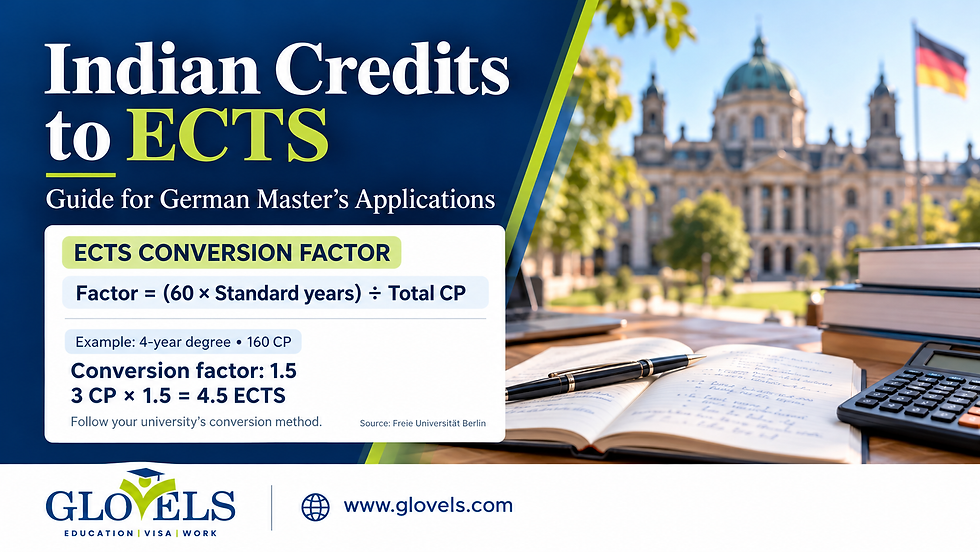
ECTS conversion factor = (60 × Standard degree duration in years) ÷ Total degree CP
Course ECTS = Course CP × ECTS conversion factor
For a four-year degree requiring 160 CP:
Conversion factor = (60 × 4) ÷ 160 = 1.5 ECTS per CP
A course worth 3 CP therefore converts to 3 × 1.5 = 4.5 ECTS under this method.
The following are illustrative factors derived from the FU Berlin formula. They are not a national conversion table applicable to every Indian qualification:
Standard degree duration | Total required original CP | ECTS conversion factor |
Three years | 120 CP | 1.5 ECTS per CP |
Four years | 120 CP | 2 ECTS per CP |
Four years | 160 CP | 1.5 ECTS per CP |
Four years | 180 CP | Approximately 1.333333 ECTS per CP |
Four years | 200 CP | 1.2 ECTS per CP |
The factor depends on both duration and the original credit total. Two four-year degrees with different credit totals therefore have different factors under this formula. Use full precision in your calculation and round the final course value only as instructed by the target university.
If the target university specifies a different multiplier or uses an automatic conversion form, follow those instructions instead. The factor is a course-conversion tool; it does not independently determine your degree’s admission equivalence.
Worked Example: Four-Year Degree with 120 CP
Assume a four-year BSc requires 120 CP, and a mathematics course carries 3 CP.
Course ECTS = 3 × (60 × 4) ÷ 120
Course ECTS = 3 × 240 ÷ 120 = 6 ECTS
Under this method, the conversion factor is 2 ECTS per CP. The 120-CP degree and 3-CP mathematics example appears in Freie Universität Berlin’s official conversion document.
The calculation establishes the subject value under that method. It does not, by itself, override a separate decision about the degree’s recognition or admission equivalence.
Worked Example: Four-Year Degree with 160 CP
For a four-year degree requiring 160 CP, the duration-based conversion factor is:
(60 × 4) ÷ 160 = 1.5
Subject credits on the transcript | ECTS under this method |
2 CP | 3 ECTS |
3 CP | 4.5 ECTS |
4 CP | 6 ECTS |
6 CP | 9 ECTS |
This factor applies to this particular combination of duration and total credits. If the degree instead requires 180 CP over four years, the factor becomes 240 ÷ 180 = 1.3333, and a 3-CP subject becomes 4 ECTS.
Do not treat “1 Indian credit = 1.5 ECTS” as a universal rule.
Why Can Course Conversion Use Four Years While Degree Equivalence Uses Three?
The two calculations answer different questions.
Assessment | Purpose | Information used |
Qualification comparison | Establish whether the first degree meets the required bachelor’s qualification type | Recognition information and programme admission rules |
Subject-credit mapping | Assess prior study in a particular academic area | Transcript credits and the target programme’s conversion instructions |
The duration-based formula distributes an assumed workload of 60 × standard years across the original credits. For a four-year programme, it therefore distributes 240 ECTS. This is a mathematical consequence of the formula, not proof that the university must recognise the qualification as a 240-ECTS admission credential.
If an application form asks for the original programme’s standard duration, enter the correct duration. Do not replace four with three just because anabin compares the qualification to “Bachelor 3j”. Conversely, do not use the formula’s 240-ECTS total to claim that a separate 210-ECTS eligibility condition has been satisfied.
Where instructions are unclear, send the admissions team your transcript, standard-duration information and degree comparison, and ask which method its form requires.
Can B.Tech. Graduates Apply to Master’s Courses Requiring 210 or 240 ECTS?
If your qualification is assessed at 180 ECTS, the numerical shortfall is:
Programme’s required prior credits | Assessed prior credits | Difference |
210 ECTS | 180 ECTS | 30 ECTS |
240 ECTS | 180 ECTS | 60 ECTS |
Eligibility depends on whether the programme permits that difference to be addressed.
Strict requirement: If the required credits must already be present and no compensation route applies, a 180-ECTS assessment does not satisfy it.
Additional modules: Some programmes allow admission with specified supplementary coursework.
Longer programme track: A university may offer a separate route designed for 180-ECTS entrants, as in Hochschule Bremen’s Electronics Engineering programme.
Recognised experience: Certain programmes allow relevant professional or practical experience to compensate for missing credits, subject to formal approval.
For example, TH Ingolstadt’s official Renewable Energy Systems admission guidance states that applicants with at least 180 but fewer than 210 ECTS may have 30 ECTS recognised through relevant professional experience, subject to its Examination Board and specified evidence requirements.
A missing 30 ECTS represents approximately one full-time semester of standard workload. It does not mean that every programme offers an extra semester or accepts any work experience. A 60-ECTS gap likewise needs a route that explicitly permits that larger difference.
Prepare a Subject-Mapping Sheet
For programmes requiring credits in particular areas, prepare a table using your transcript and syllabus:
Course | Original CP | Converted ECTS | Proposed category | Supporting document |
Calculus | 4 | 6 | Mathematics | Relevant syllabus pages |
Linear Algebra | 3 | 4.5 | Mathematics | Relevant syllabus pages |
Programming | 4 | 6 | Computer Science | Relevant syllabus pages |
Illustrative values above use a four-year, 160-CP degree and the duration-based factor of 1.5.
A subject title alone may not demonstrate the required content. Support the classification with topics, learning outcomes and assessment details. Follow the programme’s rules on overlapping categories and avoid counting the same credits twice unless its instructions expressly allow it.
If the university’s form calculates ECTS automatically, enter original credits. TUM’s curricular-analysis guidance, for example, tells applicants to use the original credits and grades rather than pre-converting them.
For lateral-entry, minor or additional-credit cases, confirm which qualification, duration and credit total the form expects. Do not add diploma years, optional minor credits or repeated attempts merely to increase the result.
Get Your ECTS Assessment Checked Before Shortlisting
Keep your transcript, degree certificate, official credit requirements, standard-duration information and relevant syllabus ready. Check both the overall degree requirement and subject-specific requirements for every shortlisted programme.
Glovels Consultants helps Indian students review academic eligibility, prepare subject mappings and shortlist German master’s programmes. Visit www.glovels.com or WhatsApp our team.


Comments